
New regulatory cooperation agreement aims to reduce technical trade barriers, support zero-tariff exports and create opportunities in agriculture, manufacturing, automotive production and green technology.
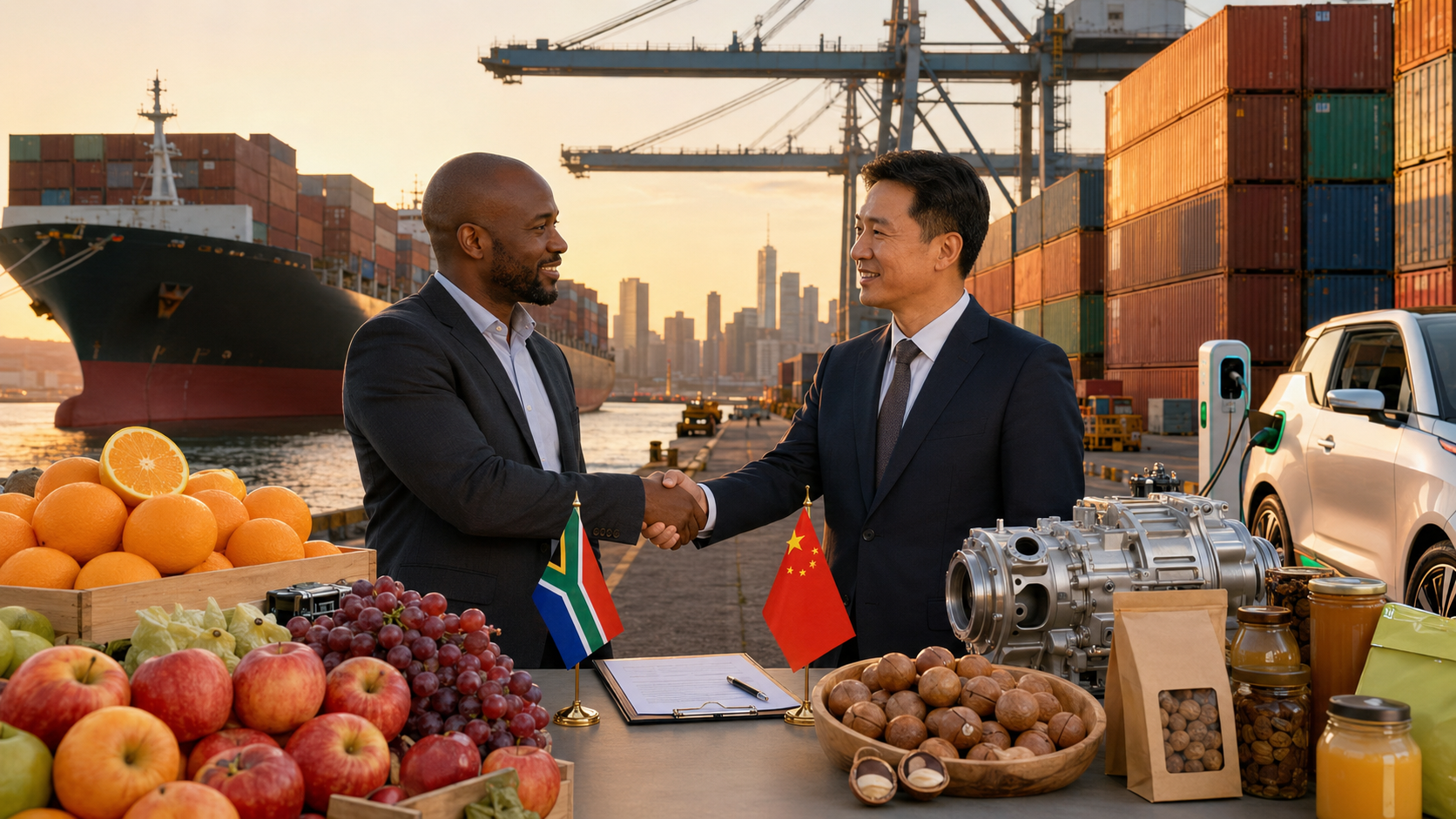
South Africa and China have taken another important step towards building stronger and more balanced trade relations by signing agreements aimed at reducing unnecessary regulatory barriers between the two countries.
The agreements establish closer cooperation between South Africa’s Department of Trade, Industry and Competition (the DTIC), China’s State Administration for Market Regulation (SAMR), and the two countries’ standards and accreditation institutions.
South African institutions involved include the National Regulator for Compulsory Specifications and the South African National Accreditation System. Their Chinese counterparts include SAMR and the China National Accreditation Service for Conformity Assessment.
The agreements were signed during a high-level meeting led by Trade, Industry and Competition Minister Parks Tau and SAMR Vice-Minister Shu Wei.
According to the dtic, the memoranda of understanding will improve cooperation on market regulation, standards, accreditation, testing, inspection and product certification.
Turning zero-tariff access into real trade
China has remained South Africa’s largest individual-country trading partner for more than a decade. South Africa is also China’s leading trading partner on the African continent.
The new agreements are expected to help both countries turn their strong political and economic relationship into practical opportunities for exporters, manufacturers, farmers and investors.
They support the Framework Agreement on Economic Partnership for Shared Development, also referred to as CADEPA, which South Africa and China signed in Beijing in February 2026. That framework provides a foundation for deeper economic cooperation and improved access to the Chinese market.
China expanded zero-tariff treatment to all 53 African countries with which it maintains diplomatic relations from 1 May 2026. The arrangement runs until 30 April 2028 for the additional 20 non-least-developed African countries, including South Africa.
Under the policy, qualifying South African goods can enter China without customs duties. Exporters must, however, comply with the relevant rules of origin and provide a valid Certificate of Origin.
The importance of the policy was demonstrated when 24 tonnes of South African apples cleared customs in Shenzhen on 1 May 2026, becoming the first African shipment to benefit from the expanded arrangement, according to the Chinese government.
This access could improve the competitiveness of South African fruit, nuts, meat, processed food, minerals and manufactured products in one of the world’s largest consumer markets.
Reducing delays without lowering standards
Removing tariffs does not automatically guarantee successful market access. Exported products must still meet China’s health, safety, packaging, labelling and technical requirements.
Businesses can experience delays when goods must be tested or certified several times because the importing and exporting countries use different systems. Differences in inspection procedures and product specifications may also increase costs, especially for small businesses.
The new agreements seek to reduce these problems through better communication, stronger institutional cooperation and greater understanding of each country’s regulatory systems.
Minister Tau stressed that easier trade should never mean weakening quality or safety standards. Instead, cooperation must remove unnecessary duplication while ensuring that every product crossing the border is properly tested and certified.
He explained that standards make market access and product compatibility possible, while accreditation gives businesses and consumers confidence in testing, inspection and certification.
Metrology — the science of accurate measurement — is equally important. Manufacturers need certainty that measurements used in production, packaging and international commerce are accepted and reliable.
Together, standards, metrology, accreditation and conformity assessment provide what is commonly called “quality infrastructure”. This system helps protect consumers while allowing trustworthy products to move more efficiently between markets.
Opportunities for important South African industries
The regulatory partnership could support cooperation in industries such as:
- Agricultural products and agro-processing
- Food safety and processed foods
- Automotive components
- New-energy vehicles
- Renewable-energy technology
- Consumer products
- Critical minerals
- Digital industries and artificial intelligence
- Advanced manufacturing
Agriculture could be one of the major beneficiaries. South Africa already has a strong reputation for citrus, apples, table grapes, avocados, macadamia nuts and other high-quality produce.
Clearer export requirements and closer cooperation between regulators could help farmers and agro-processing companies plan production more confidently. It may also lower the risk of consignments being delayed because of avoidable certification or inspection difficulties.
Manufacturers of automotive components, machinery and renewable-energy equipment could similarly benefit from more predictable testing and approval procedures.
The agreements could therefore support South Africa’s goal of moving beyond exporting mainly raw materials. Greater access for processed and manufactured products could encourage local value addition, industrial development, investment and employment.
Trade relationship built over decades
Formal diplomatic relations between South Africa and China were established in 1998. Since then, economic cooperation has expanded across mining, finance, infrastructure, manufacturing, renewable energy, agriculture and automotive production.
Total bilateral trade grew from R614 billion in 2022 to R692 billion in 2023, according to South Africa’s Department of International Relations and Cooperation.
Chinese investment has also reached banking, manufacturing and clean-energy projects. South African minerals, agricultural commodities and manufactured goods have gained a growing presence in China.
The latest regulatory agreements demonstrate that the relationship is entering a more practical stage. The focus is no longer only on opening markets, but also on ensuring that businesses can understand and meet the rules governing those markets.
A new window for South African businesses
For South African exporters, the combination of zero tariffs and stronger regulatory cooperation creates an important window of opportunity.
Businesses will still need to conduct market research, meet Chinese quality requirements, secure the correct export documentation and build dependable supply chains. Small farmers and SMMEs may also need government, industry and financial support to combine their production and supply the volumes demanded by large markets.
However, the direction is positive. Lower tariffs, clearer standards and improved cooperation can make it easier for South African products to compete in China.
If effectively implemented, the agreements could help diversify South African exports, strengthen local manufacturing, expand agro-processing and create new opportunities for businesses of different sizes.
The partnership also shows how South Africa-China trade relations can support Africa’s wider industrialisation programme. By connecting market access with quality production and value addition, the two countries are laying foundations for trade that is larger, more trusted and more beneficial to their people.