

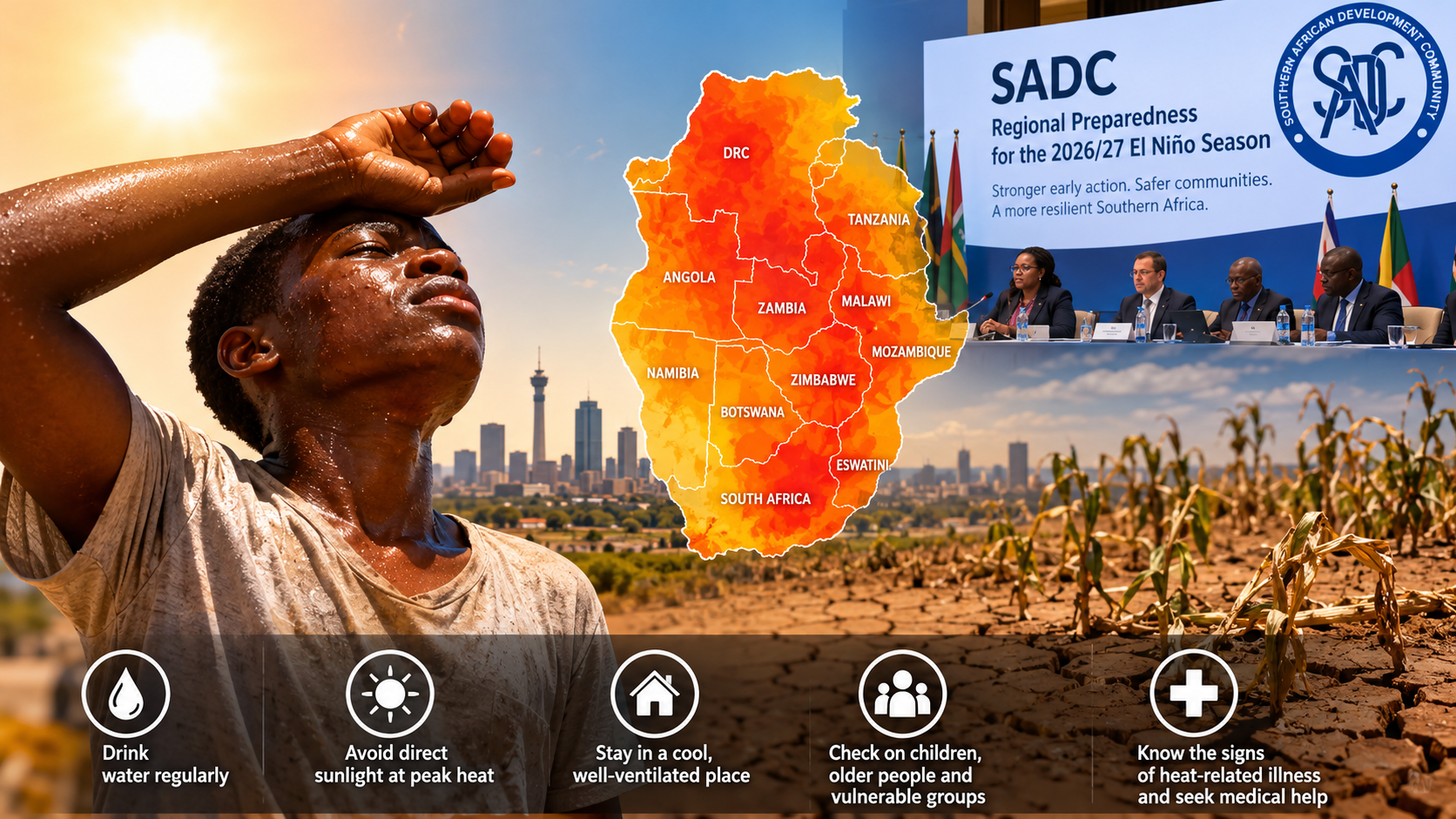
SADC countries meet in Johannesburg to strengthen disaster preparedness and anticipatory action ahead of the 2026/27 El Niño season as heatwave risks rise across Southern Africa.
By: Austin Menzi Moyo Snr.
JOHANNESBURG — Southern African countries are set to strengthen regional preparedness for the humanitarian risks expected during the 2026/27 El Niño season, as parts of the region face dangerous heat and increasingly severe climate conditions.
A regional workshop hosted in Johannesburg from 20 to 23 October 2026 will bring together the Southern African Development Community (SADC), governments, humanitarian agencies and development partners to improve disaster preparedness, anticipatory action and coordinated responses to climate-related emergencies.
The workshop is being held at The Capital on the Park in Sandton and will include representatives from the SADC Secretariat, the European Union’s DG ECHO, the Food and Agriculture Organization (FAO), the Regional Anticipatory Action Working Group (RAAWG) and national disaster management authorities.
The timing is significant. SADC’s latest regional climate outlook forecasts above-average temperatures across most of the region during the 2026/27 rainy season, alongside a strong likelihood of below-normal rainfall across much of central and southern SADC. The regional outlook identifies a strengthening El Niño as a key climate driver.
The workshop therefore seeks to move disaster management further towards acting before disasters happen, rather than waiting for humanitarian impacts to escalate.
That includes improving the use of early warnings, identifying populations at risk, preparing response measures in advance and strengthening coordination between governments and humanitarian partners.
Heat risk already being felt
The heat threat is not simply a future concern.
South Africa has experienced a series of heatwave warnings in October, with the South African Weather Service warning of persistent high temperatures in parts of KwaZulu-Natal, the Eastern Cape, Mpumalanga, Gauteng and Limpopo.
Malawi is also currently under a heatwave warning, with temperatures forecast to reach 42°C in parts of the country between 18 and 23 October. Authorities have urged residents to drink water regularly, avoid prolonged exposure to direct sunlight and take particular care of children, older people, pregnant women and people with chronic illnesses.
Mozambique issued a yellow alert earlier this month for intense heat in parts of Maputo, Gaza and Inhambane, with temperatures expected to reach up to 39°C.
Eswatini also experienced a heatwave warning in mid-October, with temperatures expected to reach 40°C and above in the Lowveld.
Has there been any fatalities yet?
As of 19 October 2026, no credible reports of any fatalities have been confirmed as directly attributed to the current October 2026 heatwave in a SADC country. However, that does not mean heat-related deaths have not occurred or will not be recorded later.
Heat deaths can be difficult to identify in real time because extreme temperatures can worsen existing heart, lung, kidney and other chronic conditions. The World Health Organization notes that heat-related deaths and hospitalisations can occur rapidly and that many deaths during heatwaves result from the worsening of underlying illnesses rather than being recorded simply as “heatstroke”.
However, the projected risk is significant. One recent Climate Impact Lab projection reported by South African media estimates that the current strong El Niño could contribute to about 1,200 additional heat-related deaths in South Africa between September 2026 and February 2027. This is a projection, not a current death toll.
How can people prevent heat-related deaths?
Health authorities say most serious heat-related illness is preventable if people respond early.
People should:
- Drink water regularly, even before they feel thirsty, while following medical advice if they have a condition requiring restricted fluid intake.
- Avoid strenuous activity during the hottest part of the day and move outdoor work or exercise to cooler morning or evening hours.
- Stay in the shade or indoors in a cool, well-ventilated place during peak heat.
- Wear loose, lightweight clothing, a hat and appropriate sun protection.
- Never leave babies, children, older people or animals in a parked vehicle, even for a short period.
- Check regularly on older people, young children, pregnant women, people with chronic illnesses, people living alone and pets.
- Take cool showers, use wet cloths or otherwise cool the body when temperatures become dangerous.
- Follow official warnings from national meteorological and health authorities rather than relying on unverified social media information.
Know the warning signs
Dizziness, severe weakness, headache, nausea, heavy sweating and muscle cramps can signal heat-related illness.
Confusion, seizures, loss of consciousness or very high body temperature are medical emergencies and can indicate heatstroke. Heatstroke can be fatal if treatment is delayed.
If someone develops signs of heatstroke, move them immediately to a cool or shaded place, remove unnecessary clothing, cool them rapidly with cool water or wet cloths and seek emergency medical assistance. WHO advises that cooling should begin immediately while professional help is being sought.
Preparing before the crisis
The Johannesburg workshop’s central message is therefore broader than the immediate heatwave.
With SADC forecasting above-average temperatures across much of the region and a strong El Niño expected to influence the 2026/27 season, regional authorities are seeking to strengthen systems that can identify risks early and trigger action before lives and livelihoods are lost.
The workshop will open on Tuesday, 20 October, with senior officials from SADC, the European Union, FAO and South Africa’s National Disaster Management Centre. It will close on Friday, 23 October, with the SADC Secretariat and South Africa, as SADC Chair, expected to deliver closing remarks.
The broader objective is to ensure that warnings translate into early action, better coordination and faster protection of vulnerable communities as Southern Africa enters a potentially challenging El Niño season.